Closed-Loop Experimental Campaigns in Practice
Most experimental work in the life sciences already follows a campaign pattern. Whether the goal is making an assay more robust, finding a better therapeutic candidate, or improving a cell culture process, teams run rounds of experiments, look at the results, and decide what to try next. But the learning between rounds usually lives in notebooks, spreadsheets, and the scientists' heads. The campaign exists, but the feedback loop is still largely manual.
That becomes a real limitation when the relevant evidence does not arrive all at once. Some signals are available within hours. Others take days, weeks, or months. At any given point in a campaign, the next decision has to be made on incomplete information.
Closed-loop learning makes that feedback loop explicit. After and even during each round, the system updates its understanding of what looks promising, what remains uncertain, and which next experiments are most worth running. It does not require every candidate to be fully characterized before it can learn. It works with the evidence available now, refines its understanding as the missing pieces arrive later, and proposes the next batch of experiments or directly drives them on available automation hardware.
The core loop
At the simplest level, a closed-loop campaign does four things over and over:
- Run a batch of candidates.[1]
- Collect whatever evidence becomes available, from assay readouts to QC data, device logs, or characterization results.
- Update the model using both current observations and remaining uncertainty.
- Choose the next batch, while continuing to fold in slower signals as they arrive.
This is where it gets interesting. The system does not only ask where do I expect the best result? It also asks where am I still most uncertain? and where would another experiment be most informative? Balancing these questions is what makes the campaign adaptive rather than static. Early rounds are often broader, mapping the space and revealing where outcomes are sensitive to certain variables. Later rounds become more selective, focusing on the regions that matter most for the decision at hand. And crucially, the campaign does not pause while waiting for slower data. It keeps moving with what it has and refines its understanding as delayed signals come in.

In practice, active learning is remarkably sample-efficient. For many real-world problems, strong results can be achieved within 80 to 100 evaluated candidates. A design space with ten parameters at three levels each contains nearly 60,000 combinations, far too many to test exhaustively. Three families of methods address this:
- Design of Experiments (DoE) picks a structured subset of conditions up front, often a few hundred runs, giving controlled coverage and statistical rigor that vastly outperforms unstructured manual exploration.
- Bayesian optimization can be seen as an iterative form of DoE: instead of fixing the full plan in advance, it updates a model after each round and proposes the next conditions, which makes it more sample-efficient on a single, well-defined objective.
- Active learning generalizes this further. It integrates a broader range of machine learning techniques, handles delayed and heterogeneous data types in the same campaign, and can learn from less explicit goal definitions, for example a target described in natural language or an example of a desired outcome rather than a hand-written scoring function.
ProviGenAI focuses on this last category, combining active learning with end-to-end campaign execution.
Assay optimization
An assay can be functional without being ready for routine use. Coefficient of variation (CV) is too high, edge effects appear unpredictably, or the protocol becomes fragile at scale. The usual fix is manual tweaking: adjust one variable, rerun, inspect, repeat.
In a closed-loop campaign, the team defines which parameters may vary and what “better” means: lower CV, higher Z′, stable signal separation, or lower reagent cost. That last one matters more than it may seem: a protocol that delivers reliable results at lower cost per plate can save significant budget when the assay runs at scale.
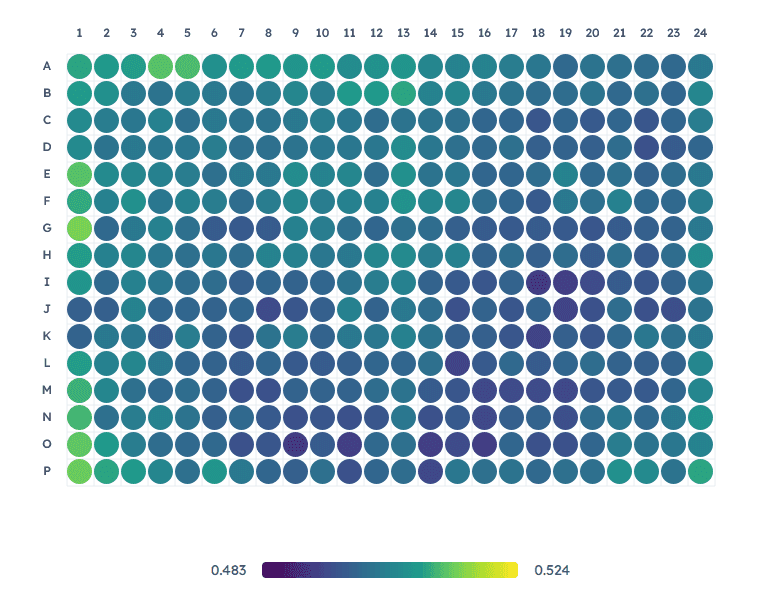
Each candidate is not a single well but a full assay condition with controls and replicates across a plate. A single well cannot tell you whether CV is acceptable, whether edge effects are under control, or whether the signal remains consistent across well positions. Those are plate-level properties, and they require plate-level evaluation.
Beyond the assay results, the system can incorporate execution context: dispense timing, shaker behavior, temperature drift, plate position effects, or environmental conditions. Over successive rounds, this reveals whether robustness problems are driven by the protocol itself or by specific execution patterns. The result is a clearer picture of why certain conditions fail and what operating ranges are safe to rely on.
Therapeutic design
In therapeutics design, the bottleneck is rarely lack of data. It is that the most meaningful data often arrives last. Binding, potency, and stability can be measured in vitro, while in vivo readouts may take weeks, months, or even years.
A closed-loop campaign starts with a broad first batch of candidates covering diverse regions of the design space. These are characterized through an initial panel of assays: binding, potency, stability. Even before any in vivo work has started, the model learns something useful. It may find that a region of the design space consistently lacks stability, or that certain candidates show a favorable potency-stability tradeoff.
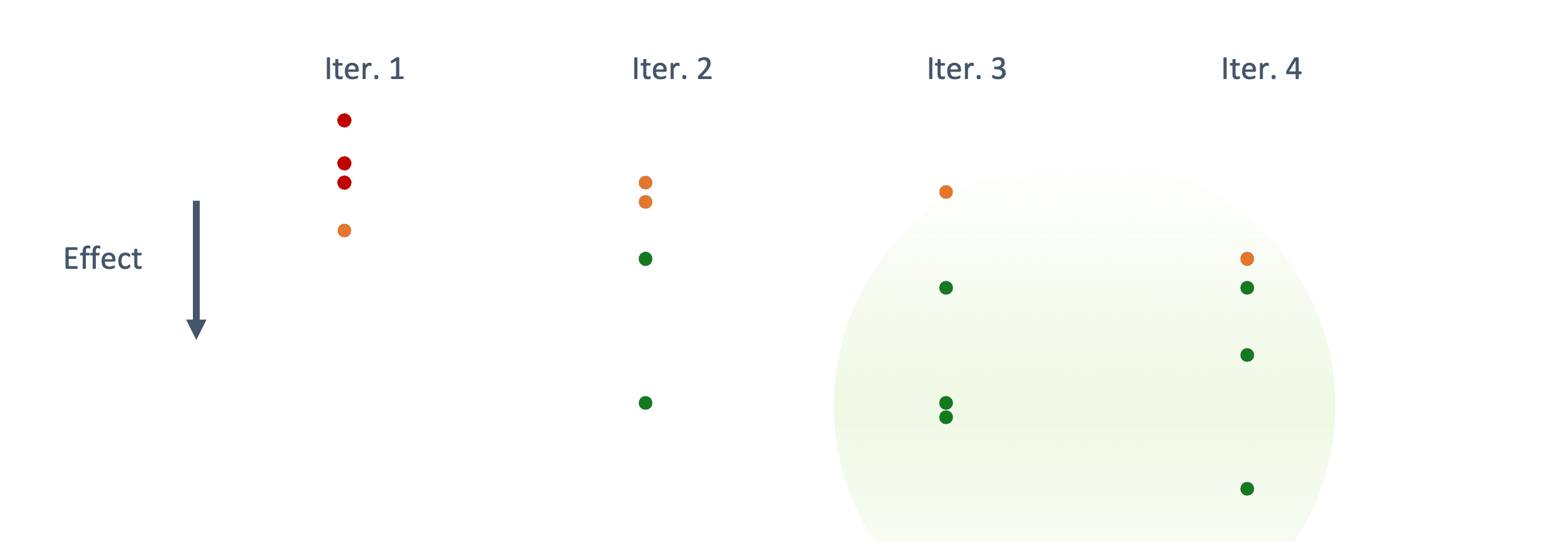
A subset of candidates then advances into more expensive downstream studies, including in vivo work. The campaign does not pause. It keeps learning from the faster assay layers while delayed data is pending.
When in vivo results eventually arrive, they are linked back to the same candidates that already have characterization data. Now the model can do something much more valuable than marking winners and losers: it starts learning which early signals actually predict downstream performance and which ones were misleading. Future candidate selection shifts accordingly, guided less by proxy performance alone and more by the patterns that genuinely translate.
Media formulation
Media formulation is rarely about one magic ingredient. Performance typically emerges from interactions between basal media, supplements, growth factors, cytokines, and timing decisions. Even with just a handful of variables, the number of possible combinations is far too large to screen exhaustively, and formulations are often constrained (for example, the fractions of a blend must sum to one).
A closed-loop campaign starts broad: the first round covers a wide range of compositions, each run with replicates. As results come in, the system collects whatever evidence is available, from cell counts and viability to process traces and environmental conditions, and updates its model without waiting for every candidate to be fully characterized.
The next set of conditions balances candidates likely to improve the target outcome against ones that would resolve open questions about interactions. For example, whether two basal media compensate for each other when blended, or whether a cytokine only helps when paired with another.
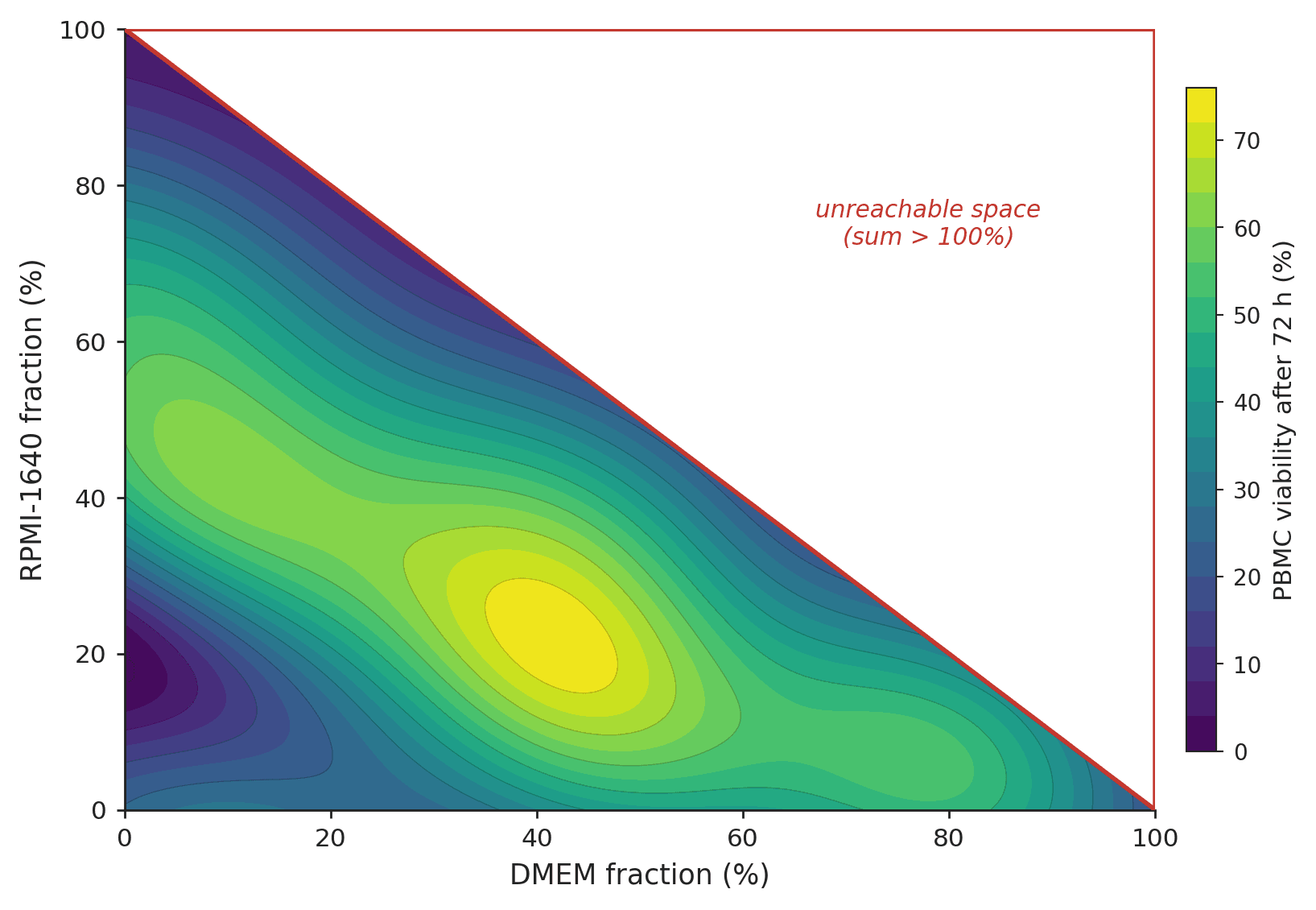
Over successive rounds, the campaign builds up a picture of the formulation space. You learn that a specific blend of commercial media outperforms any single one, that a cytokine cocktail preserves the balance of cell subpopulations better than standard mixes, or that a growth factor can be halved without losing viability. That understanding is what makes a protocol transferable and reliable at scale.
What counts as a sample?
A “sample” in a closed-loop campaign is the decision unit being evaluated, not necessarily the smallest physical unit in the lab.
In assay optimization, that may be a full assay condition summarized across a plate layout. In therapeutic design, it is often a candidate variant or variant-condition pair. In media optimization, it is typically one media or process condition evaluated with replicates.
The important point is that the sample follows the decision boundary, not the instrument boundary. Replicates strengthen confidence in that evaluation, but they do not redefine what the candidate is.
| Application | What varies | One sample | Data sources |
|---|---|---|---|
| Assay optimization | Timing, concentrations, volumes, plate handling | Condition at plate level | Well readouts, replicates, device logs, environmental data |
| Therapeutic design | Sequence, structure, modifications | Candidate with multi-stage data | In vitro screens, stability, delayed in vivo data |
| Media formulation | Composition, supplements, feeding schedule | Condition with replicates | Replicate wells/flasks, time-course, metabolic readouts |
Our active learning system is built for cases where standard Bayesian optimization struggles: multiple objectives, heterogeneous data sources (assay readouts, QC, analytics, in vivo), and signals that arrive on very different timescales. It learns how those sources relate to each other and to the outcomes that matter, which is what allows it to make useful decisions even when some signals are missing, delayed by months, or structurally different from each other.
From the user's perspective, the experience is straightforward: define what you want to achieve, and the system handles the rest, from designing the next round of experiments to programming the screening hardware, driving execution, and collecting the results. The complexity lives underneath. It surfaces as better decisions, faster results, and fewer wasted experiments.
If you are interested in exploring what a closed-loop campaign could look like for your workflow, reach out to research@provigen.ai.